
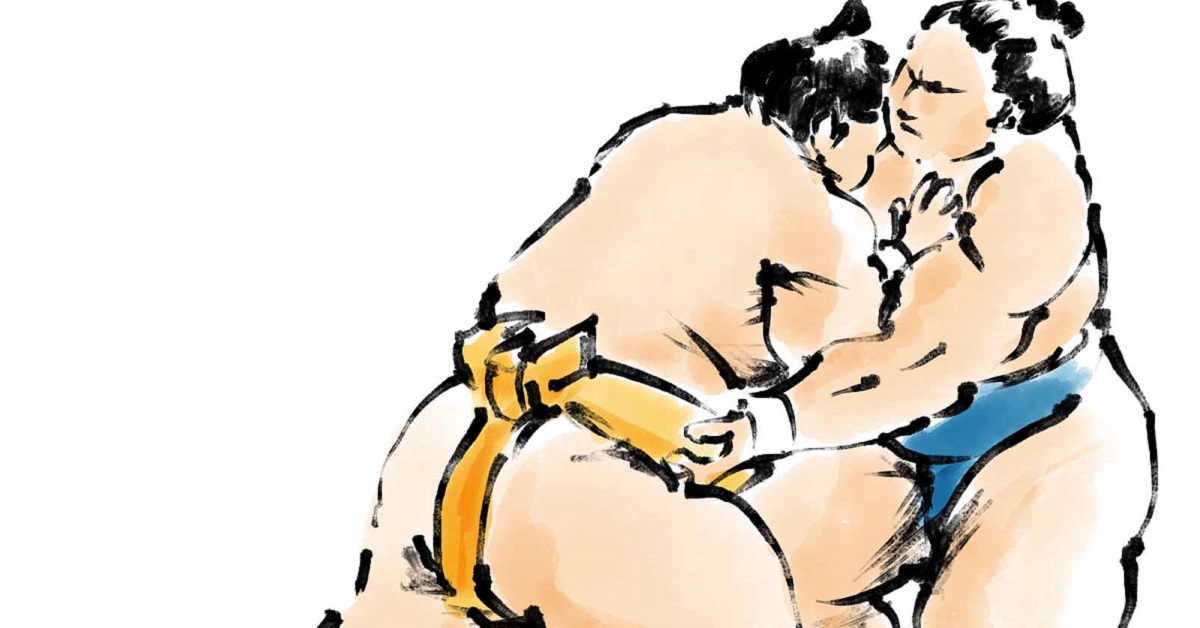

Sumo features a wide variety of techniques, and among them, “Hazu-oshi” is a fundamental yet practical pushing technique. Especially for beginners or foreign fans of sumo, understanding techniques like Hazu-oshi is a perfect way to get into the sport. In this article, we’ll explain the basics, movements, characteristics, practice tips, and tactical uses of Hazu-oshi in a way that’s easy to follow.
What is Hazu-oshi? Understanding its Role Among Pushing Techniques
Hazu-oshi is a pushing technique where a wrestler applies force from the outside of the opponent’s upper arms, targeting the area near the back of the shoulders. This move excels at breaking the opponent’s balance while maintaining distance and control. Unlike a head-on push, Hazu-oshi lifts the opponent’s arms upward and outward, disrupting their posture.
| Technique | Target Area | Ideal Range | Primary Purpose |
|---|---|---|---|
| Hazu-oshi | Back of upper arms | Mid-range | Unbalance the opponent and gain control |
| Tsuppari | Chest, neck | Mid–close | Attack while moving forward aggressively |
| Oshi-dashi | Entire torso | Close-range | Forcefully push the opponent out of the ring |
| Sashite-waza | Underarms, torso | Very close | Get inside for throws or holds |
Hazu-oshi is known for its balance of offense and defense, making it ideal for learning proper form and control.
Basic Movements and Body Mechanics of Hazu-oshi
The key to Hazu-oshi lies in pushing upward while moving forward, without losing your own balance. Here’s how the motion works, step by step:
- Take a proper stance: Stand with feet slightly wider than shoulder-width and lower your center of gravity.
- Position your hands: Place your palms on the outer sides of the opponent’s upper arms.
- Push upward forcefully: Use your lower body strength to lift and press upward.
- Step forward while pushing: Move in as you push, disturbing the opponent’s balance.
- Follow up with a finish: Once the opponent is off-balance, continue with a push-out or transition to another technique.
The angle of the push and the stability of your posture are critical. If the upward force is weak, your opponent may easily resist or counter the movement.
Key Points and Practice Tips for Beginners
For beginners practicing Hazu-oshi, there are important points to keep in mind to avoid ineffective form or injury.
| Key Point | Explanation |
|---|---|
| Keep your body axis stable | Avoid leaning too far or arching your back; stay grounded. |
| Move both hands symmetrically | Uneven hand pressure creates openings for counterattacks. |
| Time your push carefully | Push when the opponent’s balance shifts upward for maximum effect. |
| Maintain ideal distance | Too close invites grappling, too far weakens your push. |
By mastering posture, timing, and distance, your Hazu-oshi will become far more effective.
Why Hazu-oshi is Ideal for Beginners and Foreign Learners
Hazu-oshi is a technique that is visually easy to understand and physically easy to practice. It does not require excessive strength or complex grips, making it perfect for those new to sumo. For foreign participants in sumo workshops or training sessions, this technique is often one of the first taught.
Here are the skills you can develop through Hazu-oshi:
| Skill Developed | Description |
|---|---|
| Balance control | Develop a stable stance while applying forward force |
| Sense of distance | Learn to position yourself effectively without overcommitting |
| Quick decision-making | Read your opponent’s posture and act accordingly |
| Foundation for sumo | Build the basics of pushing, footwork, and body positioning |
Hazu-oshi provides the best entry point for experiencing the essence of sumo.
Technique Transitions Using Hazu-oshi in Real Matches
In real sumo bouts, a single technique rarely decides the match. Victory often depends on how well a wrestler transitions between techniques. Hazu-oshi is particularly useful for setting up follow-up moves.
| Effective Follow-ups After Hazu-oshi | Explanation |
|---|---|
| Oshi-dashi (push out) | Continue the upward momentum to force the opponent out of the ring |
| Hiki-waza (pulling moves) | When the opponent leans forward, use that momentum to pull them down |
| Throwing techniques | Fake a push, then transition to a grip and throw |
Combining Hazu-oshi with other techniques adds tactical depth to your sumo and helps you adapt during fast-paced matches.
Conclusion
Hazu-oshi is more than a simple push—it embodies the fundamentals of sumo combat. Through proper posture, balance, and timing, this technique teaches essential physical and mental skills. For beginners or foreign enthusiasts, Hazu-oshi is approachable yet powerful, offering immediate feedback and visible results.
Watching professional matches with an eye for how wrestlers use Hazu-oshi—when they apply it, how they transition from it—makes the viewing experience richer and more insightful.
Whether you’re stepping into the dohyo for the first time or looking to understand sumo more deeply, start with Hazu-oshi—it’s your first step into mastering sumo.


コメント