
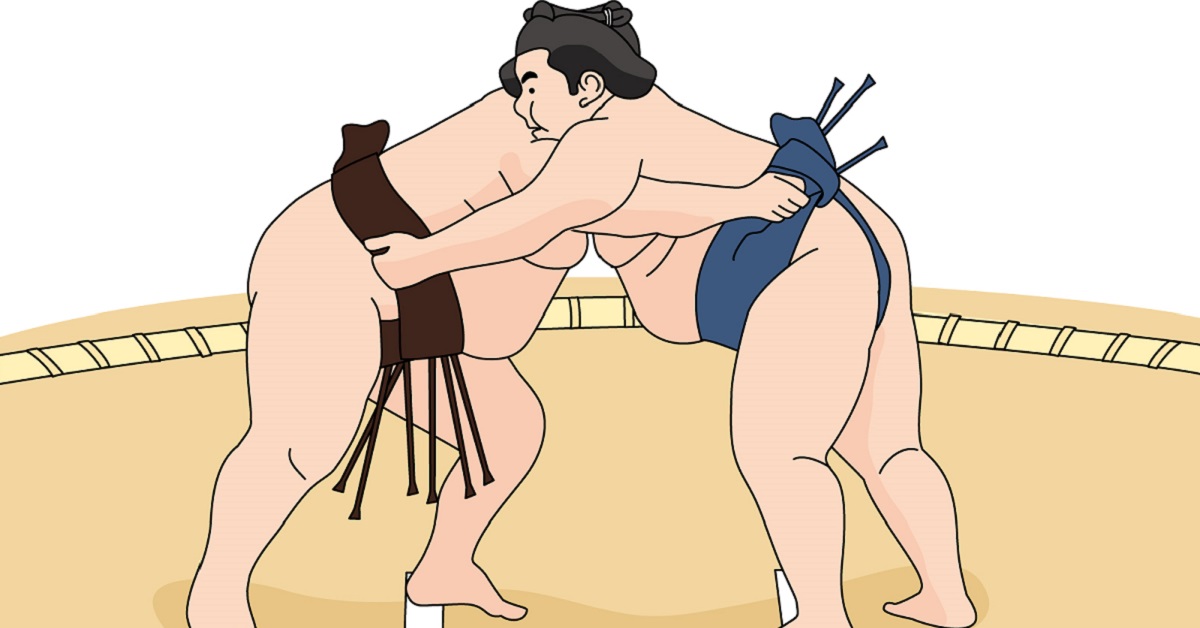

Sumo techniques often involve subtle movements that aren’t easily understood at a glance. One such movement is “ude wo kaesu”, a fundamental action frequently used during bouts. This article offers a clear and accessible explanation of this technique—its purpose, meaning, and practical usage—so that even sumo beginners or international fans can appreciate its significance.
- What Does “Ude wo Kaesu” Mean?
- The Purpose of “Ude wo Kaesu” in Sumo
- Situations Where “Ude wo Kaesu” Is Used
- Training Methods to Master “Ude wo Kaesu”
- Understanding “Ude wo Kaesu” as a Foreigner
- Examples of Masterful “Ude wo Kaesu” by Famous Wrestlers
- What to Watch for When Observing “Ude wo Kaesu”
- Conclusion
What Does “Ude wo Kaesu” Mean?
Basic Definition and Movement
“Ude wo kaesu” refers to the action of twisting one’s arm inward after grabbing the opponent’s “mawashi” (belt). By doing so, the rikishi (wrestler) pulls the opponent closer to their body, gaining control and preparing for a decisive move.
This subtle twist allows for efficient transfer of power from the arm to the opponent, enabling the wrestler to align their whole body for an effective technique. Although it may look simple, this motion is a critical aspect of sumo that wrestlers refine through daily practice.
The Purpose of “Ude wo Kaesu” in Sumo
The movement serves multiple tactical functions and is far more than just an arm motion.
| Purpose | Details |
|---|---|
| Unbalance the opponent | Twisting the arm changes the direction of force and disrupts the opponent’s balance |
| Stabilize the wrestler’s own posture | Adjusts the wrestler’s body alignment for better control |
| Sets up for the next move | Prepares for techniques like throws or “yorikiri” (force-out) |
This action is where skill surpasses brute strength, as it requires both sensitivity and control.
Situations Where “Ude wo Kaesu” Is Used
Battling for Control After the Initial Charge
Right after the “tachiai” (initial charge), wrestlers often attempt to take control by quickly executing “ude wo kaesu.” This motion allows them to gain positional advantage and dictate the bout’s pace.
As a Prelude to Throwing or Pushing Techniques
Whether preparing for a throw or a push, wrestlers often twist their arm as a setup move. This manipulation disrupts the opponent’s stance and creates the optimal moment for attack.
| Technique | Role of “Ude wo Kaesu” |
|---|---|
| Uwatenage (overarm throw) | Pulls the opponent in while destabilizing their center of gravity |
| Yorikiri (force-out) | Brings the body close for an effective push |
| Shitatedashinage (pulling underarm throw) | Enables precise timing for the throw |
No matter the technique, “ude wo kaesu” acts as a silent but powerful link between strategy and execution.
Training Methods to Master “Ude wo Kaesu”
Balance Between Flexibility and Strength
To master this movement, a wrestler needs more than strength—flexibility in the shoulder, elbow, and wrist is essential. The following exercises help improve this skill.
| Training | Purpose and Effects |
|---|---|
| Shoulder rotation drills | Increase range of motion and fluidity of movement |
| Wrist stretches | Allow precise twisting without strain |
| Simulated belt-pulling drills | Recreate match conditions and enhance muscle memory |
These training techniques are a staple in sumo practice, particularly for young wrestlers learning fundamentals.
Understanding “Ude wo Kaesu” as a Foreigner
A Technique Difficult to Translate with Words
“Ude wo kaesu” is difficult to convey with a direct English equivalent. Expressions like “twisting the arm inward” or “torquing the wrist” do not fully capture the movement’s purpose or context. Thus, visual aids such as videos or live demonstrations are far more effective.
| English Phrase | Nuance Captured | Comments |
|---|---|---|
| Arm twisting | General concept only | Lacks clarity |
| Pulling inward | Suggests correct direction | Doesn’t reflect twisting motion |
| Wrapping motion | Too vague | Needs explanation |
A Gateway into Sumo’s Cultural Depth
For international fans, learning about “ude wo kaesu” reveals that sumo isn’t just about brute force. It involves deep strategy and precise body mechanics. This realization often marks the beginning of a deeper appreciation for sumo as both sport and cultural heritage.
Examples of Masterful “Ude wo Kaesu” by Famous Wrestlers
Several great sumo wrestlers were known for their excellent use of this technique.
| Wrestler | Signature Use of “Ude wo Kaesu” |
|---|---|
| Asashoryu | Swift inward twists leading seamlessly into powerful throws |
| Hakuho | Controlled, full-body coordination with minimal exertion |
| Terunofuji | Dominates early exchanges using powerful arm rotations |
By watching these wrestlers, one can see how a small twist can dictate the outcome of an entire match.
What to Watch for When Observing “Ude wo Kaesu”
Focusing on when and how “ude wo kaesu” occurs during a bout enhances the viewing experience.
| Observation Point | What to Look For |
|---|---|
| Initial grapple | Is the arm twisting as the mawashi is grabbed? |
| Just before the technique | Are wrist and shoulder movements subtle or exaggerated? |
| Right after the win | Did the twist set up the victory? |
These cues offer insight into the silent tactics that shape every match.
Conclusion
“Ude wo kaesu” may seem like a minor gesture, but it holds enormous weight in the world of sumo. It serves as a bridge between form and function, strategy and strength. For newcomers and international fans alike, understanding this movement is key to appreciating the depth of sumo.
Rather than seeing sumo as a series of clashes, recognizing techniques like this reveals a sport rooted in tradition, skill, and mindfulness. “Ude wo kaesu” is not only a technique—it’s a window into what makes sumo so deeply respected and enduring.
コメント